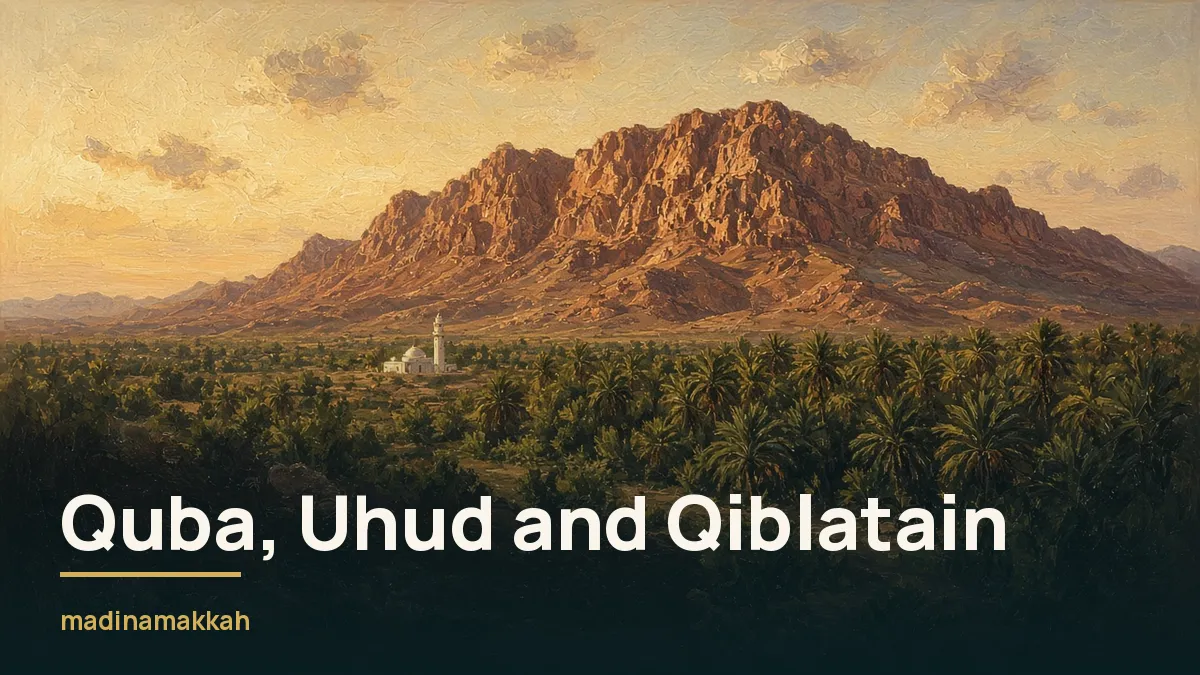
Beyond the Prophet’s Mosque, many pilgrims spend a morning visiting places connected to the early history of Islam in Madinah. These visits are optional. They are not part of Umrah, and you do not lose anything by skipping them. If you go, go with the right intention and a calm pace.
For families living in Madinah, see our weekend guide to Quba and Uhud.
Quba Mosque
Quba is the first mosque built in Islam. The Prophet (peace be upon him) laid its foundation when he arrived near Madinah after the Hijrah.
He used to visit Quba regularly, riding or walking. He also taught that whoever purifies himself at home, then comes to Quba Mosque and prays in it, has a reward like that of an Umrah.
Practical points:
- Make wudu before you leave your room, following the Sunnah.
- Pray two rak’ahs in the mosque.
- Saturday mornings are a popular time, following the Prophet’s practice, so expect more people then.
- Men and women have separate prayer areas. Agree a meeting point before you go in.
Mount Uhud and the martyrs’ graves
Uhud is the mountain north of the city where the Battle of Uhud took place. Seventy companions were martyred there, including Hamzah ibn Abd al-Muttalib, the Prophet’s uncle (may Allah be pleased with him).
Visitors come to remember them and to send greetings of peace on those buried there. The Prophet (peace be upon him) said of Uhud: “This is a mountain that loves us, and we love it.”
Practical points:
- The graveyard is fenced. Stand at the boundary and give your salam and dua quietly.
- Do not touch, wipe, or take anything from the graves, and do not ask anything of the dead. Ask Allah alone.
- The area is open and hot. Go early in the day, wear a hat or cover your head, and carry water.
- Climbing the small hill nearby, known as the Archers’ Hill, is common but uneven underfoot. Take care, especially with elderly companions and children.
Masjid al-Qiblatain
Masjid al-Qiblatain, the “Mosque of the Two Qiblahs,” is linked by tradition to the time when the direction of prayer changed from Jerusalem to the Kaaba in Makkah. It is a quiet reminder of a turning point in the life of the early Muslims.
Pray two rak’ahs if it is not a time when prayer is disliked, and move on calmly.
Keep the visit simple and correct
People bring many customs to these places, and not all of them have a basis. Scholars differ on some practices at historical sites. A few general points most people can agree on:
- Visit to remember, to pray, and to learn, not to collect places.
- Make dua to Allah directly.
- Do not tie threads, leave notes, or rub walls and railings for blessing.
- Keep your voice low and do not crowd others who are praying.
If you are unsure about any practice, ask the scholar with your group.
How to get there
Most groups arrange these visits together, often in one morning. If you are going on your own, ask your group leader which transport they recommend, and agree a return time so you do not miss the next prayer in the Prophet’s Mosque.
Do not tire yourself out
The heart of your time in Madinah is the Prophet’s Mosque. If a morning of visits will leave you too tired for the prayers there, choose fewer places, or just Quba. A short visit done well is better than a long one done in a rush.
Source: Practical arrangements change. Check the Saudi Ministry of Hajj and Umrah, Nusuk, and local notices on the day for current guidance.
Leave a Reply