
Author: Malik Sherjeel Awan

  • Sa’i Between Safa and Marwah: What to Expect

    Sa’i Between Safa and Marwah: What to Expect

    Sa‘i is the walk between the hills of Safa and Marwah, inside Masjid al-Haram. It comes after tawaf in Umrah. This post describes what the walk feels like and how to pace yourself. For rulings that differ by school of law, ask the scholar with your group.

    The shape of the walk

    You start at Safa. Face the Kaaba, praise Allah, and make dua. Then walk toward Marwah. That is one length. Walking back to Safa is the second. You complete seven lengths in this way and finish at Marwah.

    The path is long, covered, and shared by thousands of people. It is not a race track. Expect heat, slow patches, and moments where the crowd thickens near the ends. Wear shoes you can walk in for a long stretch, and keep a small bag for them if you need to remove them for prayer later.

    Green-light areas

    Along the path there are marked stretches (often shown with green lights or green markers) where men who are able may walk more quickly or jog if it is safe. Women walk at a normal pace throughout. If the stretch is packed, men should also walk normally. Safety and not harming others come first.

    Do not shove to reach the green area. Do not film yourself jogging in a way that blocks the path. If a companion cannot keep up with a faster pace, stay with them.

    Hydration and pace

    Sa‘i takes time, especially when the mosque is full. Drink water before you start, and again if you feel dry during the walk. Zamzam and water points are available in and around the mosque; use them without leaving bottles in the walkway.

    Set a pace you can hold for all seven lengths. Many first-timers start too fast after tawaf and tire by the fourth or fifth length. A steady walk is enough. Rest at Safa or Marwah if you need a short pause, then continue. Sitting in the middle of the path blocks others; step to the side if you must stop.

    Elderly people and companions

    If you are with an elderly parent, a pregnant woman, or someone with limited mobility:

    • Agree before you start whether you will stay together the whole way.
    • Prefer a calmer time of day if your schedule allows.
    • Use a wheelchair route if one is open and needed; follow staff directions.
    • Do not leave a vulnerable companion alone in a dense crowd while you “finish quickly.”

    Children tire and get thirsty. Plan short rests and keep them close. Agree a meeting point near Safa or Marwah in case someone is separated.

    Counting and finishing

    Keep a clear count of the seven lengths. Losing count is common when you are tired. A companion can help, or you can count on your fingers. If you are unsure whether you completed seven, ask the scholar with your group before you leave the area.

    When you finish at Marwah, make dua, thank Allah, and move calmly toward the next step of your rite (for Umrah, that is usually cutting or shortening the hair). Do not rush into the exit tunnels in a way that knocks into others.

    Sa‘i remembers Hajar’s search for water for her child. Walk it with patience, care for the weak beside you, and trust that a sincere, steady effort is enough.

    Source: Practical arrangements change. Check the Saudi Ministry of Hajj and Umrah, Nusuk, and the official Saudi visa site for current entry rules.
  • Tawaf Tips for a Crowded Day

    Tawaf Tips for a Crowded Day

    Tawaf is seven circuits around the Kaaba. On a quiet night it can feel spacious. On a crowded day it feels like a river of people. This post is about staying calm and completing tawaf safely. It is not a full fiqh treatise. Where schools of law differ, ask the scholar with your group.

    Direction and starting point

    Walk with the Kaaba on your left. Each circuit begins and ends at the line of the Black Stone. You do not need to touch the Black Stone. If you can reach it easily without pushing, you may. If you cannot, raise your hand toward it from where you are and continue. Never shove anyone to get closer.

    Count your circuits carefully. Crowds make it easy to lose count. Some people use the fingers of one hand. Others ask a companion to help keep the count. If you lose track, ask the scholar with your group what to do; do not invent a fix from a stranger next to you.

    Choosing a floor or level

    Masjid al-Haram has more than one level for tawaf. The mataf (the open area closest to the Kaaba) is the most sought after and often the most crowded. Upper floors are usually calmer and still valid for tawaf when they are open for that purpose.

    Choose the level that matches your strength and the day’s crowd. Elderly companions, people with limited mobility, and anyone who feels dizzy in a crush are often better on a quieter floor. Follow the signs and the mosque staff. If a level is closed or redirected, do not argue; move where they point.

    Pace and tiredness

    There is no prize for finishing first. Walk at a pace you can keep for seven circuits. Men may walk more briskly in the first three circuits when the space allows; if the crowd is tight, walk normally. Women walk at a normal pace throughout.

    If you feel faint, step out of the flow toward a quieter edge, sit if you can do so without blocking a path, drink water, and rest. Finish when you are steady again. Leaving the flow briefly to recover is better than collapsing in the middle of the mataf.

    Do not push

    Pushing is never part of worship here.

    • Do not force a path through people who are slower than you.
    • Do not stop suddenly in the middle of the flow to take a photo.
    • Keep walkways clear when you pause to make dua.
    • Give way to wheelchairs, elderly walkers, and families with small children.

    Mosque staff are there to keep people moving safely. If they ask you to shift, slow down, or change direction, follow them at once.

    Making dua in the crowd

    You may remember Allah and make dua in your own words throughout tawaf. There is no fixed script you must recite. Keep your voice soft so you do not disturb others. If tears come, that is fine; just keep moving with the flow so you do not become an obstacle.

    After the seven circuits

    When you finish the seventh circuit, move calmly out of the main flow. Pray two short rak‘ahs where there is room, without blocking a doorway or a path. Drink Zamzam if you can, and make dua. Then prepare for sa‘i, or rest if you need to.

    A crowded tawaf is still a tawaf. Patience, a clear count, and respect for the people around you matter more than a perfect photo or a perfect spot next to the Kaaba.

    Source: Practical arrangements change. Check the Saudi Ministry of Hajj and Umrah, Nusuk, and the official Saudi visa site for current entry rules.
  • Entering Ihram: Clothes, Timing, and What to Avoid

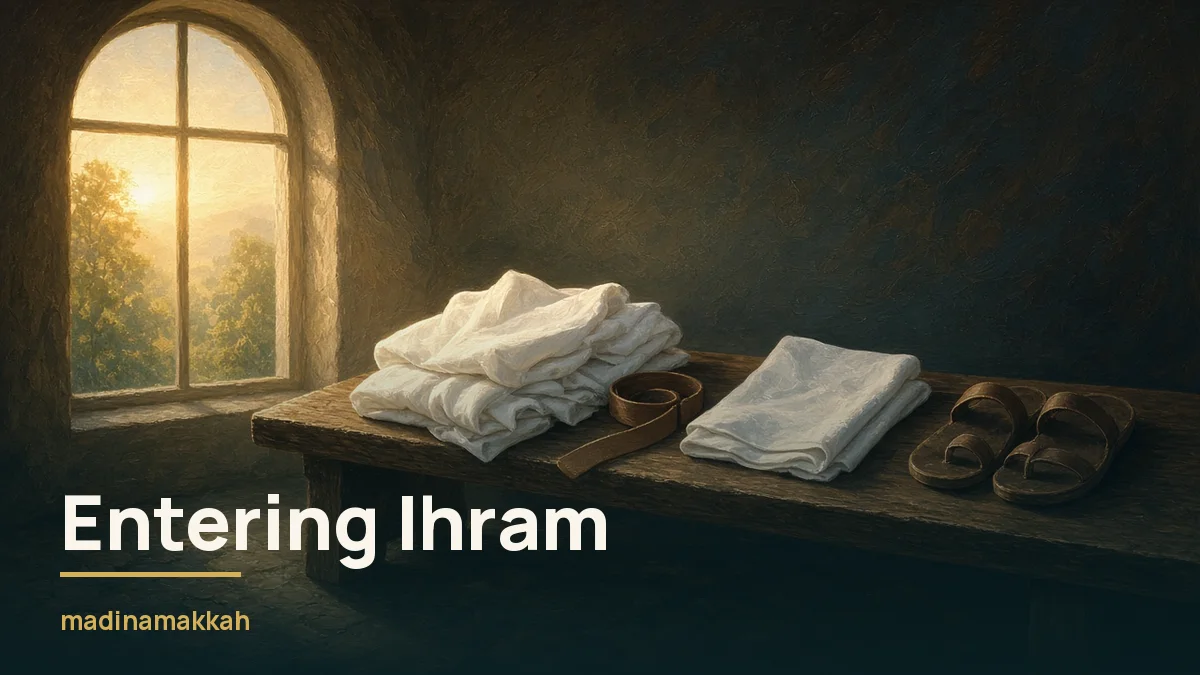
    Entering Ihram: Clothes, Timing, and What to Avoid

    Ihram is the sacred state you enter for Umrah or Hajj. This post covers the practical side: clothes, timing, and what to avoid while you are in it. It is not a full walkthrough of Umrah. For the whole sequence, see the step-by-step Umrah guide on this site.

    When to enter ihram

    You must be in ihram before you pass the miqat for your route. The miqat is a fixed boundary on the way to Makkah. If your flight crosses that boundary in the air, you enter ihram on the plane before you reach it.

    No airport is a miqat. Do not plan to land, collect bags, and then look for a place to change. Find out the miqat for your route before you leave home. Your group leader or the scholar with you can confirm it. Do not guess from a short video.

    If you can, bathe and put on ihram clothes calmly before the call comes. A wash is recommended, not a condition of the rite. Once you have made the intention and begun the talbiyah, you are in ihram.

    What men wear

    Men in ihram wear two plain, unstitched cloths:

    • One cloth around the waist, covering from the navel to below the knees.
    • One cloth over the shoulders.

    A belt or pouch that holds the lower cloth without stitching it into a garment is widely used. If you are unsure whether a particular belt or sandal is allowed for you, ask the scholar with your group before you fly, not in a crowded aisle.

    Men do not cover the head while in ihram. Keep a light umbrella or stay in shade if the sun is strong; do not wrap a cloth on the head as a covering.

    What women wear

    Women wear their usual modest clothes. There is no special color and no special uniform for ihram.

    In ihram, a woman does not wear a face veil that covers the face, and does not wear gloves. She keeps her hair covered as she normally would for prayer and public life. If any detail feels unclear for your school of law, ask the scholar traveling with your group.

    Intention and talbiyah

    Make the intention for Umrah (or for the Hajj you are performing) in your heart. Say the words your scholar taught you, then begin the talbiyah and keep it going on the way to Makkah. Stop the talbiyah when you begin tawaf.

    If you forget a wording, remember Allah in your own words and ask the scholar with you as soon as you can. Do not invent a ruling from a phone search in the moment.

    What to avoid while in ihram

    At a high level, people in ihram avoid:

    • Perfume and scented products on the body or clothes.
    • Cutting hair or nails.
    • Marital relations.
    • Hunting land animals.

    Men also do not cover the head with a garment, as noted above.

    Schools of law differ on some details: what counts as covering, what to do if you cut a nail by mistake, and what is owed if a rule is broken. This site does not settle those questions. Ask the scholar with your group, and follow the mosque staff if they give a practical instruction on the day.

    Small practical tips

    • Pack ihram clothes in the cabin bag, not in the hold.
    • Prefer unscented soap once you are close to entering ihram.
    • Keep a spare pin or belt that your scholar has already said is fine.
    • Stay calm if the aircrew announces the miqat earlier or later than you expected. Follow the announcement and your group’s plan.

    Entering ihram is the start of a sacred time. Dress simply, time it correctly for your route, and leave the fine points to the scholar with you.

    Source: Practical arrangements change. Check the Saudi Ministry of Hajj and Umrah, Nusuk, and the official Saudi visa site for current entry rules.

  • Before You Fly: A First-Timer Checklist

    Before You Fly: A First-Timer Checklist

    The days before you fly are part of the journey. You do not need a perfect plan. You do need a few things settled, so the airport and the miqat do not catch you off guard.

    Check the entry rules yourself

    Visa types, permits, and what you may carry change. This site does not list them, because a copied rule goes out of date. Before you travel, read the current pages of the Saudi Ministry of Hajj and Umrah, Nusuk, and the official Saudi visa site. If a line is unclear, ask the organizer or the scholar with your group, not a stranger online.

    Know where ihram starts for your route

    You enter ihram before you pass the miqat on your way to Makkah. If you are flying past that point, you enter ihram on the plane, before you cross it. No airport is a miqat. Do not plan to wait until you land and then look for a place to change.

    Find out the miqat for your route before you leave home. Do not guess it from a video.

    Pack ihram where you can reach it

    Put your ihram clothes in the cabin bag, not in the hold.

    Men wear two plain, unstitched cloths: one around the waist, one over the shoulders. A belt to hold the lower cloth is widely used. If you are unsure whether a belt is allowed for you, ask the scholar with your group before you fly, not in the aisle.

    Women wear their usual modest clothes. There is no special color and no special uniform. In ihram, a woman does not wear a face veil and does not wear gloves.

    A small list for the cabin bag

    • Unscented soap, for a wash before ihram if you can make one. The wash is not a condition of the rite.
    • Shoes you can slip off and carry.
    • Any medicine you already take, in its usual packing.
    • A copy of your travel documents, kept separate from the originals.

    Leave strong perfume at home. Once you are in ihram, perfume is one of the things you avoid. Where the details differ between schools, ask the scholar with your group.

    Agree who you will ask

    Crowds, a missed step, and a woman’s monthly cycle all come up on a first Umrah. Decide now, while you are calm, that you will ask the scholar traveling with your group. Do not settle a ruling from a short video on the plane.

    Source: Practical arrangements change. Check the Saudi Ministry of Hajj and Umrah, Nusuk, and the official Saudi visa site for current entry rules.

  • Visiting the Prophet’s Mosque for the First Time: Etiquette

    Visiting the Prophet’s Mosque for the First Time: Etiquette

    A visit to the Prophet's Mosque is not itself an Umrah or a Hajj rite, and you do not wear ihram for it.

    If you live in Madinah, see our guide to booking a Rawdah permit on Nusuk.

    Many pilgrims visit Madinah before or after their Umrah or Hajj, out of love for the Prophet (peace be upon him) and for the reward of praying in his mosque. There is a well-known report, attributed to Bukhari and Muslim, that a prayer in this mosque is better than a thousand prayers elsewhere, except the Sacred Mosque in Makkah.

    Here is how to visit with good manners.

    Before you go

    • Be clean and in wudu, so you can pray as soon as you arrive.
    • Wear modest, clean clothes.
    • Carry little: a small bag, your phone on silent, and a bag for your shoes.

    Entering the mosque

    1. Enter with your right foot.
    2. Say a short dua for entering a mosque if you know one, or remember Allah in your own words.
    3. Pray two rak'ahs to greet the mosque in a place where you are not blocking anyone.
    4. Keep your voice low from the moment you step inside.

    Men and women

    Men and women may be guided to different areas, entrances, or times on the day. Follow the mosque staff, and agree a meeting point with your family or group beforehand.

    Greeting the Prophet (peace be upon him)

    The grave of the Prophet (peace be upon him) lies within the mosque, with the graves of Abu Bakr and Umar (may Allah be pleased with them) beside it.

    1. Move with the flow of people toward the grave area. Do not stop in the middle of the line.
    2. Offer salam to the Prophet (peace be upon him) in a low voice, for example: As-salamu 'alayka ya Rasulallah (Peace be upon you, O Messenger of Allah). Send blessings upon him.
    3. Then offer salam to Abu Bakr (may Allah be pleased with him).
    4. Then offer salam to Umar (may Allah be pleased with him).
    5. Move on so that others can come forward.

    What to avoid

    • Do not wipe the screen or the walls.
    • Do not push to get closer.
    • Do not raise your voice, call out, or argue in the line.
    • Do not stop to take long photos or videos.

    Making dua

    When you make dua, face the qiblah, as you would in any mosque, and ask Allah directly. Ask for yourself, your family, your parents, and the whole ummah, in any language you like.

    The Rawdah

    The Rawdah is a special area of the mosque, between the Prophet's (peace be upon him) house and his minbar. Many visitors hope to pray there.

    • Access is organised by the authorities and the arrangements can change.
    • Follow the staff at all times.
    • Pray briefly and calmly, then make room for the next person.

    If you are not able to reach the Rawdah, do not be sad. Praying anywhere in the mosque is a blessing.

    Baqi

    If you visit the cemetery of Baqi, keep the visit short and calm, and follow the staff.

    Leaving

    Leave calmly, stepping out with your left foot. Collect your shoes, check your belongings, and meet your group at the place you agreed.

    Where schools of law differ on the details of the visit, ask the scholar with your group.

    Source: Practical arrangements change. Check the Saudi Ministry of Hajj and Umrah, Nusuk, and the official Saudi visa site for current entry rules.
  • Things to Take Care of in Madinah

    Things to Take Care of in Madinah

    Madinah is known for its calm. Many visitors say it is the place where they finally slow down. A little care in everyday things helps keep it that way, for you and for everyone around you.

    For more on coping with the heat, see our Madinah heat safety guide.

    Heat and water

    Madinah can be very hot, especially in the middle of the day.

    • Drink water often, before you feel thirsty. Carry a small bottle.
    • Rest in the hottest hours if you can, and plan walks for cooler times.
    • Cover your head from the sun when you are outside, and use an umbrella if it helps.
    • Watch the elderly and children in your group. Heat affects them faster.
    • Know the signs of heat exhaustion, such as dizziness, headache, or nausea. Move into shade, drink, and get help if it does not pass.

    Comfortable shoes

    You will walk more than you expect: to the mosque, around it, and back again, several times a day.

    • Wear shoes you have already walked in. New shoes can cause blisters.
    • Choose shoes that are easy to take off and put on.
    • Carry a small bag for your shoes inside the mosque, or remember exactly where you left them.

    Keep your belongings safe

    • Keep your bag closed and in front of you in crowds.
    • Carry only what you need. Leave valuables you do not need in your room.
    • Keep your phone secure, and do not leave it on the floor while you pray.

    Know the prayer times

    Life in Madinah moves around the five daily prayers.

    • Check the prayer times each day, and plan to arrive early.
    • The areas around the mosque fill quickly before each prayer. Arriving early means less rushing and a calmer place to pray.
    • Agree a meeting point with your group for after the prayer.

    Keep walkways and doorways clear

    • Do not sit, pray, or stand in walkways and doorways where people need to pass.
    • Do not leave bags or shoes in a path.
    • If you need to stop to check your phone or wait for someone, step to the side.

    Speak quietly

    The Prophet's Mosque is a place of worship and reflection. Keep your voice low, inside the mosque and in the courtyards around it. Keep phone calls short and quiet, and put your phone on silent.

    Be patient with crowds

    You will meet people from every part of the world. Everyone is tired, everyone is far from home, and everyone wants the same thing.

    • Do not push. If a space is full, wait or find another.
    • Let others go first when you can.
    • Smile, and assume the best of people.

    The Rawdah

    The Rawdah inside the Prophet's Mosque is often very crowded.

    • Do not push to get closer.
    • Follow the staff. Access is organised by the authorities, and arrangements can change.
    • Pray briefly and calmly, then make room for others.

    Other mosques and places

    Many visitors also pray at Quba Mosque and visit other places in and around Madinah. These visits are optional. They are not a checklist.

    Do not exhaust yourself trying to see everything. Keep your strength for the prayers in the Prophet's Mosque, for rest, and for caring for the people with you.

    Where schools of law differ on any of these visits, ask the scholar with your group.

    Look after each other

    Check on your companions often, especially the elderly. Share water, wait for slower walkers, and keep your group together. Good character is part of the visit.

    Source: Practical arrangements change. Check the Saudi Ministry of Hajj and Umrah, Nusuk, and the official Saudi visa site for current entry rules.

  • How to Perform Umrah, Step by Step

    How to Perform Umrah, Step by Step

    Umrah is made up of a few clear acts, performed in order: entering ihram, tawaf around the Kaaba, sa'i between Safa and Marwah, and shaving or shortening the hair. This guide walks through each one briefly.

    Hajj is a different rite, with its own days and places, and is not covered here.

    1. Ihram

    Ihram is the sacred state you enter for Umrah. You must enter it before you pass the miqat for your route. If you are flying, that can mean entering ihram on the plane before the point in the air parallel to the miqat. No airport is a miqat, so do not plan to wait until you land. Check the miqat for your route before you travel.

    Clothing:

    • Men wear two plain, unstitched cloths: one around the waist and one over the shoulders.
    • Women wear their usual modest clothes. There is no special uniform. In ihram, a woman does not wear a face veil that covers the face, and does not wear gloves.

    While in ihram, avoid perfume, cutting hair or nails, and marital relations. Men do not cover the head.

    Where schools of law differ, ask the scholar with your group.

    2. Intention and talbiyah

    Make the intention for Umrah in your heart. Then say:

    Labbayka Allahumma 'Umrah. Here I am, O Allah, for Umrah.

    Then begin the talbiyah:

    Labbayka Allahumma labbayk. Labbayka la sharika laka labbayk. Innal-hamda wan-ni'mata laka wal-mulk. La sharika lak.

    Here I am, O Allah, here I am. Here I am, You have no partner, here I am. All praise, all blessings, and all sovereignty are Yours. You have no partner.

    Repeat it often on the way to Makkah. Stop when you begin tawaf.

    3. Tawaf

    Tawaf is seven circuits around the Kaaba.

    1. Start at the Black Stone. Face it, and touch it if you can reach it easily. If you cannot, raise your hand toward it from where you are. Do not push to reach it.
    2. Walk with the Kaaba on your left.
    3. Complete seven circuits, each ending back at the line of the Black Stone.
    4. Make dua and remember Allah in your own words throughout. There is no fixed wording you must say.

    For men: for this tawaf, you may uncover the right shoulder by passing the upper cloth under the right arm. You may also walk briskly in the first three circuits, but only if the crowd allows. Walk normally for the rest.

    After tawaf: pray two short rak'ahs where there is room, without blocking anyone. Then drink Zamzam water and make dua.

    4. Sa'i

    Sa'i is seven lengths between the hills of Safa and Marwah, inside the mosque.

    1. Start at Safa. Face the Kaaba, praise Allah, and make dua.
    2. Walk to Marwah. That is one length. Walking back to Safa is the second.
    3. Finish at Marwah after the seventh length.

    Men walk quickly between the green markers if it is safe to do so. Women walk normally throughout.

    5. Shaving or shortening the hair

    • Men shave the head or shorten the hair.
    • Women gather the hair and cut about a fingertip's length from the ends, in private.

    After this, your Umrah is complete and ihram ends. Thank Allah, and ask Him to accept it from you.

    A note for women

    A woman on her period does not perform tawaf until she is able. This is common, and nothing to be anxious about. She should ask the scholar with her group about her situation rather than guess.

    If something goes wrong

    Mistakes happen, especially in crowds and when you are tired. Do not panic, and do not guess what is owed. Ask the scholar with your group as soon as you can.

    Source: Practical arrangements change. Check the Saudi Ministry of Hajj and Umrah, Nusuk, and the official Saudi visa site for current entry rules.
  • Visiting Masjid al-Haram for the First Time

    Visiting Masjid al-Haram for the First Time

    Your first visit to Masjid al-Haram, the Sacred Mosque in Makkah, is a moment many people wait their whole lives for. It can also feel overwhelming. The mosque is vast, the crowds can be large, and emotions run high.

    For residents of Makkah, see our guide to getting an Umrah permit on Nusuk.

    This guide covers the visit itself: arriving, entering, and your first moments inside. The full Umrah rite, step by step, is in the next post.

    Before you leave your room

    Make wudu. Arrive clean and in wudu, so you can pray as soon as you are inside.

    Wear modest clothes. Choose loose, clean, modest clothing. If you are already in ihram for Umrah, keep to the rules of ihram.

    Carry little. A small bag, your phone, and what you truly need. The less you carry, the easier it is to move and to keep track of your things.

    Use the toilet first. Lines can be long once you are inside, and walking back out takes time.

    Shoes

    You will take your shoes off before entering the prayer areas. Plan for them before you arrive.

    • Carry a small cloth or plastic bag for your shoes.
    • If you use a shoe rack, note exactly where it is. Many racks look alike.
    • Do not leave shoes in a walkway where people may trip over them.

    Entering the mosque

    1. Step in with your right foot.
    2. Say a short dua for entering a mosque if you know one, such as: Allahumma-ftah li abwaba rahmatik (O Allah, open for me the doors of Your mercy). If you do not know one, remember Allah in your own words.
    3. Walk calmly. There is no need to hurry. Keep to the side if you need to stop.

    Make a note of the door you came in by, so you can find your way back and meet your companions.

    Your first sight of the Kaaba

    This is the moment people remember for the rest of their lives.

    • Pause. Step out of the flow of people if you can, and stand still for a moment.
    • Make dua. Ask Allah for whatever is in your heart: for yourself, your family, and the ummah.
    • Do not rush a photo. Let the moment be worship first. If you want a picture, take it later, briefly, and without stopping in someone's path.

    Moving through the crowd

    The Sacred Mosque welcomes people of every age and ability. Elderly people, children, and wheelchair users share the same space.

    • Do not push. Ever. If the way ahead is blocked, wait or take another route.
    • Keep walkways and doorways clear. Do not sit, pray, or gather in paths that people need to use.
    • Stay with your group, and agree a meeting place in case you are separated.
    • Be gentle with others. People are tired, emotional, and far from home. A smile and patience go a long way.

    Praying when it is crowded

    When the mosque is full, you may not reach the place you hoped for. That is fine.

    • Pray where you can, in a space where you are not blocking a walkway or doorway.
    • Follow the rows and the guidance of the mosque staff.
    • Do not step over people who are sitting, or squeeze into a row where there is no room.

    Leaving

    When you are ready, leave the way you came in, calmly. Step out with your left foot. Collect your shoes, check you have your belongings, and meet your group at the place you agreed.

    Where schools of law differ on any detail of the visit, ask the scholar with your group.

    Source: Practical arrangements change. Check the Saudi Ministry of Hajj and Umrah, Nusuk, and the official Saudi visa site for current entry rules.

  • What This Site Is: A Guide for Umrah and Hajj

    What This Site Is: A Guide for Umrah and Hajj

    Peace be upon you, and welcome.

    www.madinamakkah.com is a practical guide for people going to Makkah and Madinah. Whether this is your first journey or you have been before, it is here to help you prepare with a clear mind and a settled heart.

    Why we made it

    Many people prepare for Umrah or Hajj with a lot of questions and very little quiet time. Advice comes from every direction: family, friends, videos, and group chats. Some of it is helpful. Some of it is confusing, and some of it is out of date.

    This site tries to be a simple place to start. Short pages, plain words, and steps you can follow.

    What you will find here

    How the rites work. Step-by-step guides to the acts of Umrah, in the order you perform them: ihram, the talbiyah, tawaf, sa'i, and cutting the hair. We explain what to do and what to avoid, without long theory.

    First visits to the two mosques. What to expect the first time you enter Masjid al-Haram in Makkah and the Prophet's Mosque in Madinah. How to enter, how to behave in a crowd, and how to keep your attention on worship rather than on your phone.

    Everyday care in the two cities. Practical reminders for daily life: heat and water, comfortable shoes, keeping your belongings safe, being patient with crowds, and looking after the people around you.

    Packages

    Umrah and Hajj packages are part of this site. The current list will be published shortly. These guides do not quote prices, and they do not describe a package that is not on that list yet.

    Entry permission and permits come from the Saudi authorities through their official channels.

    A note on scholarship

    The acts of Umrah and Hajj are taught in detail by the schools of Islamic law, and the schools sometimes differ on smaller points. This guide gives the common, practical steps. It does not give rulings.

    Where schools of law differ, ask the scholar with your group.

    How to use this guide

    1. Read before you travel. The guides are short so you can read them at home, more than once, with your family. Arriving already knowing the steps makes the day itself much calmer.
    2. Follow the order. If you are preparing for Umrah, start with the step-by-step Umrah guide, then read the first-visit guides for the two mosques.
    3. Keep it light on the day. You do not need to memorise every line. Know the main steps, learn the talbiyah, and carry a few short duas you know well. You can make dua in your own language.
    4. Check official sources for anything practical. Visas, permits, and entry rules are set by the Saudi authorities and can change. Always confirm them on the official sites before you travel.
    5. Ask when you are unsure. If something does not fit your situation, do not guess. Ask the scholar with your group.

    A final word

    The journey to Makkah and Madinah is about worship, patience, and good character. The aim of this site is to take a little worry off your shoulders so you can give more attention to what matters.

    May Allah make your journey easy and accept it from you.

    Source: Practical arrangements change. Check the Saudi Ministry of Hajj and Umrah, Nusuk, and the official Saudi visa site for current entry rules.