Tag: ihram

  • What Women Wear in Ihram: The Official Guidance Explained

    What Women Wear in Ihram: The Official Guidance Explained

    Men’s ihram is easy to picture: two white sheets. For women there is no single “ihram outfit”, and that leaves many first-time pilgrims unsure what to pack and what to avoid.

    This guide sets out what the Ministry of Hajj and Umrah’s Ihram Guide says about women’s clothing in ihram. It is practical guidance, not a ruling. For anything specific to you, ask a qualified scholar.

    Quick answer

    Short answer: A woman enters ihram in her own modest clothing. The Ministry’s guide says it should be loose, cover properly, allow free movement and not be ornamental. The two clothing items the guide lists as prohibited for women in ihram are the niqab and gloves.

    No special garment

    Ihram is a state you enter with intention and the Talbiyah, not a uniform. The Ministry’s Umrah Guide says women “may wear any modest clothing that is neither ornamental nor revealing”. That means you can use clothes you already own. You do not need to buy a special white set.

    The Ministry’s conditions for women’s ihram clothing

    • Loose-fitting, not tight or shaping
    • Covering appropriately
    • Does not restrict movement, so you can walk Tawaf and Sa’i comfortably
    • Not ornamental or designed for adornment

    What about colour?

    The Ministry’s guides do not set a colour for women. White is common, and so are black, grey, beige and other plain shades. Pick something plain that meets the conditions above. If your scholar or group has a preference, follow it.

    The two prohibitions specific to women

    The Ihram Guide lists two items as “prohibitions for women”: wearing the niqab and wearing gloves. This matches a well-known hadith on what a woman in ihram does not wear (Sahih al-Bukhari 1838).

    The same guide also lists something that is not among the prohibitions: a woman covering her face in the presence of non-mahram men. So it names the fitted niqab as prohibited while listing face covering as not prohibited. How to do that in practice is a question for your scholar.

    Questions to take to a scholar

    • How may I cover my face in crowds without a niqab?
    • Are socks and closed shoes fine for me?
    • Can I use pins, a cap under my scarf or a sports-style hijab?
    • What applies if my period starts before or during Umrah?

    We list these only as questions. We do not answer them here.

    General ihram prohibitions still apply

    Women also observe the general prohibitions listed in the guide, which apply to everyone in ihram. These include wearing perfume and cutting hair or nails (MoHU Ihram Guide). Plan ahead and pack unscented toiletries for the days you are in ihram. Applying fragrance before you enter ihram is fine; the guide even mentions it as a sunnah. It is during ihram that perfume is prohibited.

    The guide also lists things that are not prohibited, such as bathing, wearing sandals and bandaging wounds. That is reassuring for long days in the heat.

    Practical tips for choosing what to wear

    Before you pack

    • Two or three loose, plain abayas or long dresses, so you can change
    • Breathable fabrics for heat and long walking
    • Plain headscarves that stay in place without fuss
    • Comfortable, broken-in footwear
    • Unscented soap, shampoo and deodorant for the days in ihram

    Our guide to what to carry into the Haram covers the day bag for each visit, and our practical notes for women on Umrah cover privacy, prayer spaces and crowds.

    Tip

    Try your outfit on a long walk at home first. If it rides up, slips or makes you too hot, change it before the trip, not in the Mataf.

    Common mix-ups

    “Ihram clothes must be new.” The guides do not say this. Clean, modest clothing you already own meets the conditions.

    “Women cannot wear sewn clothing.” The rule against sewn or tailored garments is listed in the Ihram Guide under prohibitions for men, not women. Women wear normal sewn clothes.

    “The headscarf must be white.” No colour is set. Any plain scarf that covers properly works.

    “Once in ihram, I cannot wash.” The guide lists bathing as not prohibited. Just keep to unscented products.

    If you hear a rule from a friend or online that is not in the official guide, check it with your scholar before you worry.

    When to change into ihram clothing

    You can dress before you leave your hotel or before the flight. The point of entering ihram is the intention and Talbiyah at or before the miqat, not the moment you put on the clothes. Our guide to entering ihram and our page on the miqat for Umrah explain the timing.

    A simple sequence

    1

    Prepare: pack your ihram clothes and unscented toiletries.

    2

    Dress: put on clothing that meets the guide’s conditions.

    3

    At the miqat: make your intention and begin the Talbiyah.

    4

    Avoid: niqab and gloves while in ihram, plus the general prohibitions.

    5

    At the end: cut a small amount from the ends of your hair to leave ihram (Nusuk).

    The last step is explained in our guide to halq and taqsir after Umrah.

    FAQ

    Do women have to wear white in ihram?

    The Ministry’s guides do not require a colour for women. They set conditions on the cut and style instead.

    Can I wear my normal abaya?

    If it is loose, covering, allows free movement and is not ornamental, it meets the guide’s conditions.

    Can I wear gloves for the sun?

    The guide lists gloves as prohibited for women in ihram. Ask your scholar about alternatives.

    Last checked 4 November 2026 against the Ministry of Hajj and Umrah Ihram Guide and Umrah Guide. This is a practical guide, not a ruling; ask a qualified scholar about your own case.
  • Halq or Taqsir: Cutting Hair and Leaving Ihram After Umrah

    Halq or Taqsir: Cutting Hair and Leaving Ihram After Umrah

    After the final circuit of Sa’i at Marwah, most pilgrims feel a mix of relief and joy. One step remains: cutting the hair. This is how Umrah is completed and how you leave the state of ihram.

    This guide explains what the official guides from the Ministry of Hajj and Umrah and Nusuk say, the practical choices you will face, and where to get it done safely. It does not give rulings. For your own situation, especially anything unusual, ask a qualified scholar.

    Quick answer

    Short answer: After Tawaf and Sa’i, men shave the whole head (halq) or shorten the hair (taqsir), and women cut a small amount from the ends of their hair. The Ministry’s Umrah Guide says this completes Umrah, and what was forbidden in ihram becomes permitted. Use a licensed barber or do it yourself at your hotel.

    What halq and taqsir mean

    Halq (حلق) means shaving the head. Taqsir (تقصير) means shortening the hair. Both words appear in the official guides as the two ways a man ends his Umrah. The step as a whole, cutting the hair and leaving ihram, is called tahallul.

    What the official guides say

    • Men: shave the whole head or shorten the hair (MoHU Umrah Guide)
    • Women: cut a fingertip’s length from the ends; Nusuk describes it as 1–2 cm (Nusuk)
    • Timing: after completing Tawaf and Sa’i
    • Restrictions: ihram restrictions stay in place until the hair is cut (Nusuk)

    Shave or shorten? Questions for men

    Many men choose to shave, and many choose to shorten. A well-known hadith records the Prophet ﷺ making dua for those who shaved their heads. The Companions asked about those who shorten, and he repeated the dua for those who shaved before naming those who shorten as well (Sahih al-Bukhari 1727). Both appear in the same report, and the post leaves the choice between them to your scholar.

    The Ministry’s guide also notes a point for people combining Umrah with Hajj. It says that in Umrah al-Tamattu the pilgrim must trim without shaving (MoHU Umrah Guide). If you are travelling in the Hajj months, check this with a scholar before you go.

    Questions to take to a scholar

    • How much hair counts as shortening, and from which parts of the head?
    • Can I use electric clippers, and on what setting?
    • I have very little hair or am bald. What should I do?
    • I forgot, or left ihram before cutting. What now?

    We list these as questions only. Please do not rely on forum answers.

    For women

    The official guidance is short: women do not shave. They cut a small amount from the ends of their hair. The Ministry’s guide describes it as a fingertip’s length, and Nusuk says 1–2 cm (Nusuk).

    In practice, many women do this privately in their hotel room, with a husband, a mahram or a female relative helping. Bring a small pair of scissors in your bag so you are not looking for one late at night. Our practical notes for women on Umrah cover privacy and comfort more broadly.

    Where to get it done

    The Ministry’s guide says there is no need to cut hair in the Mas’a (the Sa’i area), and that licensed barbershops are available around the Grand Mosque (MoHU Umrah Guide). Nusuk adds that you may postpone the cut until you return to your residence, and have it done by yourself or by those with you (Nusuk).

    Licensed barber near the HaramAt your hotel
    SpeedQuick, straight after Sa’iDepends on the walk back
    PrivacyPublic shopPrivate
    ToolsProvided by the barberBring your own scissors or razor
    Best forMen shavingWomen; men shortening
    Licensed barber or at the hotel?

    Hygiene: what licensed barbers must do

    The Ministry’s guide lists what licensed shops must do. Use it as a checklist when you sit down.

    Licensed barber checklist (MoHU Umrah Guide)

    • A new blade or new scissors for each person
    • Sterilised scissors
    • Approved powders and liquids
    • Hands washed before each haircut

    If a shop or street offer does not meet these points, walk away. Unlicensed roadside “barbers” near the Haram are best avoided.

    Warning

    Cutting hair is not required in the Sa’i area. The Ministry’s guide points pilgrims to the licensed barbershops around the Grand Mosque. If you cut it elsewhere, put the hair in a bin rather than leaving it behind.

    Step by step at the end of Umrah

    Finishing your Umrah

    1

    Finish Sa’i: the seventh circuit ends at Marwah.

    2

    Decide where: a licensed barber nearby or back at your hotel.

    3

    Cut the hair: men shave or shorten; women cut a small amount from the ends.

    4

    Leave ihram: change clothes. Restrictions end once the hair is cut, per the guides.

    Our step-by-step Umrah guide shows how this fits with the earlier rites, and our guide on Sa’i between Safa and Marwah covers the step just before.

    After you leave ihram

    Take a moment. Many pilgrims make dua, call family and rest. Our guide to what to do after Umrah has ideas for the rest of your stay.

    FAQ

    Do I have to cut my hair immediately after Sa’i?

    Nusuk says you may postpone it until you return to your residence, but the ihram restrictions remain until you cut it.

    Can my husband cut my hair?

    Nusuk says pilgrims may have it cut by those with them. Ask your scholar if you have specific questions.

    Is the barber’s price fixed?

    Prices vary from shop to shop, so ask before you sit down.

    Last checked 4 November 2026 against the Ministry of Hajj and Umrah Umrah Guide and Nusuk. This is a practical guide, not a ruling; ask a qualified scholar about your own case.
  • Miqat for Umrah: Which One Applies to Your Route (Including by Air)

    Miqat for Umrah: Which One Applies to Your Route (Including by Air)

    A miqat is a set point that pilgrims heading for Makkah do not pass without being in ihram. Which one applies to you depends on the direction you travel from, and on whether you arrive by road, by train or by air.

    This guide is logistics only. It names the miqats and their distances from the Ministry of Hajj and Umrah, as of 4 November 2026. What you must do at the miqat, and what happens if a plan goes wrong, are questions for a qualified scholar.

    Quick answer

    Short answer: The Ministry of Hajj and Umrah lists five miqats: Dhul Hulayfah (Abyar Ali), Al-Juhfah (many pilgrims now use Rabigh), Qarn al-Manazil (Al-Sail Al-Kabeer), Yalamlam (Assadiyyah) and Dhat Irq. The Ministry also says pilgrims arriving by air must not pass the miqat, or the point parallel to it, without ihram, and that Jeddah’s airport is not a miqat.

    Key takeaways

    • Five miqats: listed with their distances from Makkah by the Ministry of Hajj and Umrah.
    • By air: the point that matters is where your flight passes the miqat or its parallel, per the Ministry.
    • Jeddah airport: King Abdulaziz International Airport is neither a miqat nor a place for entering ihram, per the Ministry.
    • Ask early: settle your plan with your group’s scholar before you travel.

    The five miqats and the routes they serve

    The miqats are mentioned in hadith collections, including Sahih al-Bukhari 1524, Sahih Muslim 1181a and, for Dhat Irq, Sahih al-Bukhari 1531.

    For Dhat ‘Irq, Sahih al-Bukhari 1531 reports that ‘Umar set it for the people of Iraq, and Sahih Muslim 1183b reports Jabir naming it, with the narrator unsure whether Jabir attributed it to the Prophet ﷺ. Scholars differ on whether the Prophet ﷺ set Dhat ‘Irq or ‘Umar did; either way, it is accepted as a miqat.

    The distances below are the Ministry of Hajj and Umrah’s figures, measured from Makkah.

    MiqatArabicAlso known asDistance from MakkahRoute it serves
    Dhul Hulayfahذو الحليفةAbyar Ali420 kmComing from or through Madinah
    Al-Juhfahالجحفة—187 kmThe Levant, Egypt and Morocco (Saudi Press Agency)
    Qarn al-Manazilقرن المنازلAl-Sail Al-Kabeer94 kmNajd and Taif
    YalamlamيلملمAssadiyyah115 kmYemen, Tihama and neighbouring areas
    Dhat Irqذات عرق—92 kmIraq and that direction
    The five miqats (distances: Ministry of Hajj and Umrah; alternative names: Saudi Press Agency)

    The Ministry notes that many pilgrims today enter ihram at Rabigh, a different place from the original Al-Juhfah site. The Saudi Press Agency says the original site was lost to flooding, which is why Rabigh is used. It also says the authorities provide guidance, washrooms and first aid at the miqat sites.

    At 420 km, Dhul Hulayfah is the farthest of the five from Makkah, per the Ministry’s figures. If you start your journey to Makkah from Madinah, confirm the plan with your group before you set off.

    Flying in: what changes by air

    Most international pilgrims fly. You do not land at a miqat. The Ministry of Hajj and Umrah says pilgrims residing beyond the miqat and arriving by air must not pass the miqat, or the point parallel to it, without ihram.

    That has two practical results. First, you may need to be ready before the plane lands. Second, your ihram kit belongs in your cabin bag, not in the hold. Our Umrah packing list for men covers what to pack.

    Planning your ihram for a flight

    1

    Ask your group’s scholar, before you book, which point applies to your route and when you should be ready.

    2

    Ask your airline or group whether the crew announces when the flight nears the miqat.

    3

    Pack your ihram kit in your cabin bag.

    4

    Allow time on the plane, or before you board, to get ready without rushing.

    5

    If you plan to go to Madinah first, ask how that changes your plan.

    Note

    If you land in Jeddah and travel on to Makkah by Haramain train, our Jeddah airport to Makkah by train guide covers the journey. The ihram plan still needs to be settled before you land.

    By road or train inside Saudi Arabia

    If you are travelling to Makkah from Madinah, by road or train, Dhul Hulayfah is your miqat. Ibn ‘Abbas reported that the Prophet ﷺ set it for the people of Madinah (Sahih al-Bukhari 1524; Sahih Muslim 1181a); the Ministry of Hajj and Umrah reproduces that narration. It serves the people of Madinah and those passing through it. Our guide to travelling between Makkah and Madinah covers transport options.

    From Taif and the Najd direction, the Ministry lists Qarn al-Manazil, also called Al-Sail Al-Kabeer, 94 km from Makkah. Exactly where and when to get ready on a train or coach journey is a question for your scholar or group leader.

    If you live in Saudi Arabia or are in transit

    The Ministry’s miqat page has guidance by place of residence, including for people already inside the miqat boundaries, such as residents of Jeddah or Makkah. Read the Ministry’s page and ask a scholar how it applies to you.

    If you have a stopover in Saudi Arabia, see our guide to Umrah on a transit visa, and ask your scholar about the ihram plan before you fly.

    Questions to take to your scholar

    Ask before you travel

    • Which miqat, or which parallel point, applies to my exact route?
    • When should I be ready on my flight?
    • What should I do if I pass the miqat without being in ihram?
    • I live in Jeddah, Makkah or elsewhere in Saudi Arabia. Where do I start?
    • I am visiting Madinah first. Does that change things?

    This site does not answer these questions. Our guide to entering ihram covers the practical side, and the full sequence of Umrah is in how to perform Umrah, step by step.

    FAQ

    Is Jeddah airport a miqat?

    No. The Ministry of Hajj and Umrah says King Abdulaziz International Airport is neither a miqat nor a place for entering ihram.

    Which miqat applies to flights from Europe or Asia?

    It depends on your flight path. Ask your group’s scholar and your airline before you travel.

    Which miqat applies if I travel from Madinah to Makkah?

    It is Dhul Hulayfah, also called Abyar Ali. The Prophet ﷺ set it for the people of Madinah (Sahih al-Bukhari 1524; Sahih Muslim 1181a).

    Last checked: 4 November 2026. Miqat list and distances: Ministry of Hajj and Umrah miqat page (last updated 19 October 2026). Al-Juhfah flooding and facilities: Saudi Press Agency. Confirm your own plan with a qualified scholar.

  • Umrah Packing List for Men

    Umrah Packing List for Men

    Packing for Umrah is simpler than it looks. Most men overpack, then carry a heavy bag through airports, hotel lobbies and crowded courtyards. A short, well-sorted list saves energy for what you came for.

    This list is practical only. It covers what to pack and where to put it. Anything about what ihram allows, such as belts, sandals or scented products, is a question for the scholar with your group.

    Quick answer

    Short answer: Pack in three parts. Your cabin bag carries documents and your ihram kit, because the Ministry of Hajj and Umrah says Jeddah’s King Abdulaziz International Airport is not a miqat. Your checked bag carries clothes for the rest of the trip, light layers and toiletries. A small daily bag holds only what you need at the mosque. As of 31 October 2026, check entry rules on official pages before you travel.

    Key takeaways

    • Ihram goes in the cabin bag: the Ministry’s miqat page says air travellers must not pass the miqat, or the point parallel to it, without ihram.
    • Copies of documents: GOV.UK’s pilgrimage advice says to take photocopies, keep one with you and leave one with family.
    • Medicines: pack enough for the whole trip, including a delayed return, as GOV.UK advises.
    • Pack light: you will carry the daily bag for hours at a time.

    Documents and essentials

    Put these in a zipped inner pocket of your cabin bag, not in the hold.

    Documents

    • Passport, with the validity your visa route requires
    • Your visa, saved on your phone and printed
    • Your Umrah permit in the Nusuk app, plus a screenshot in case the signal drops
    • Vaccination certificate: see our Umrah vaccination requirements
    • Health insurance details: see what Umrah health insurance covers
    • Hotel and transport bookings, and your group leader’s details
    • Photocopies of your passport and visa, kept apart from the originals

    Leave one set of copies with family at home. If anything goes missing, our guide to lost belongings and documents at the Haram explains where to go.

    The ihram kit for your cabin bag

    Because Jeddah’s airport is not a miqat, you may need to change into ihram before landing or before a set point on the road. That means the kit has to be reachable, not buried in a suitcase in the hold.

    Ihram kit

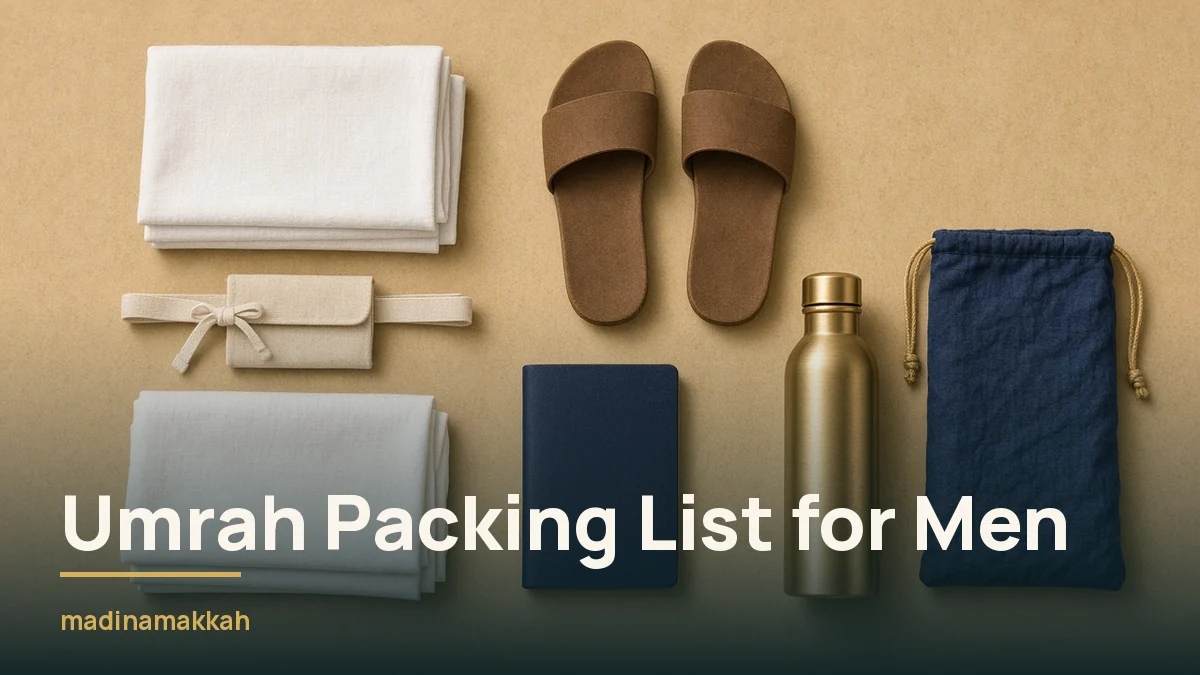
    • Two plain ihram cloths, plus a spare set in case one gets wet or dirty
    • A pouch belt or safety pins, if your scholar has said they are fine for you
    • Sandals that are easy to slip off and carry
    • Unscented soap and unscented toiletries
    • A small towel
    • A plastic or cloth bag to hold the clothes you take off

    What men wear in ihram, and what to avoid while in it, is covered in our guide to entering ihram. If you are unsure whether a belt, a sandal style or a product is acceptable, ask your group’s scholar before you fly, not in the aisle.

    Tip

    Practise putting the cloths on at home once. Changing on a plane or in a small washroom is much easier if you already know how the cloths sit.

    Clothes for the rest of the trip

    After Umrah, you will spend days walking between your hotel and the mosque. Comfort matters more than variety.

    • Loose, breathable clothes: a few sets you can wash in the hotel and wear again.
    • A light layer: air-conditioned halls, buses and evenings can feel cool. Our winter Umrah guide covers layers and rain.
    • Socks: for the hotel, the flight and cooler mosque floors.
    • Broken-in shoes or sandals: new footwear on long walks is a common cause of sore feet.
    • Something to sleep in and a spare set of clothes in the cabin bag, in case your checked bag is delayed.

    Your daily bag for the mosque

    Keep the day bag small and close to your body. A cross-body pouch or a small zipped backpack leaves your hands free.

    ItemCabin bagChecked bagDaily bag
    Passport and visaYesNoCopy only, unless your hotel or group says otherwise
    Ihram kitYesSpare setNo
    Everyday clothesOne spare setYesNo
    MedicinesYesBack-up supplyToday’s doses
    Phone and power bankYesNoYes
    Shoe bag and water bottleNoYesYes
    Where each item goes

    Our post on what to carry into the Haram goes through the day bag item by item. Rules at the gates can change, so follow staff and mosque notices on the day.

    Medicines and health items

    Bring only the medicines you already take, in their original packaging, with a copy of your prescription. GOV.UK’s pilgrimage advice says to pack enough for the entire trip, including if your return is delayed.

    Some medicines need extra care at Saudi customs. Read our guide to Saudi customs rules for pilgrims before you pack them, and ask your doctor or pharmacist if you are unsure about any item.

    What to leave at home

    Warning

    Saudi Arabia has strict customs rules. GOV.UK’s entry requirements page lists items it is illegal to import, including alcohol, pork products and weapons, and items that need special approval, including some pharmaceutical products. Check before you pack.

    Leave behind heavy books, extra gadgets and more clothes than you need. Space in your checked bag is useful on the way home, for example if you plan to bring Zamzam water: see our Zamzam guide for the official carriage rules.

    Strong perfumes and scented products are best left out of the ihram kit. Whether a particular product is acceptable is, again, a question for your scholar.

    FAQ

    Should ihram go in my checked bag?

    No. Keep it in your cabin bag. The Ministry of Hajj and Umrah says Jeddah’s airport is not a miqat, so you may need to change before landing.

    How many ihram sets should men pack?

    Many pilgrims pack two sets, so there is a spare if one gets wet or dirty. This is a practical choice, not a rule.

    Can I wear my usual belt or trainers in ihram?

    Ask the scholar with your group before you travel. This site does not give rulings on ihram.

    Last checked: 31 October 2026, against the Ministry of Hajj and Umrah miqat page, GOV.UK travel advice and Nusuk. Entry and customs rules change, so confirm on official pages before you travel.