By Dr. Malik Sherjeel Awan, PsyD · Last verified 22 November 2026 · Free to print and share
Published by Dr. Malik Sherjeel Awan, Makkah
Keep this page open on your phone on the day you perform Umrah. It walks you from your hotel room to the moment you leave ihram, one step at a time, with a simple map of the Haram. Every Qur’an verse and hadith is linked to its source.
Download the free PDF (A4, 2 pages)
No sign-up and no email. Print it or save it to your phone.
1. Before you leave the hotel
- Your Umrah permit in the Nusuk app for today’s time slot (take a screenshot in case the signal drops). See how to book it.
- Your passport or ID, the hotel card with its address, and a charged phone (a small power bank helps).
- Water, any medicines, and a small bag for your sandals.
- A meeting point agreed with your group: a numbered gate is easiest. Photograph the gate number when you go in.
- Wudu before you leave, so you are ready for tawaf: the Prophet ﷺ made wudu and then did tawaf when he reached Makkah (Sahih al-Bukhari 1614).
2. Ihram and the talbiyah
You enter ihram, with the intention for Umrah, before you pass the miqat. If you came by air, this happened before landing or at the miqat on the road; if you live or stay inside the miqat, ask about your own case. See the miqat for Umrah, entering ihram and what women wear in ihram. Repeat the talbiyah on the way to the Haram:
لَبَّيْكَ اللَّهُمَّ لَبَّيْكَ، لَبَّيْكَ لَا شَرِيكَ لَكَ لَبَّيْكَ، إِنَّ الْحَمْدَ وَالنِّعْمَةَ لَكَ وَالْمُلْكَ، لَا شَرِيكَ لَكَ
Labbayk Allahumma labbayk, labbayka la sharika laka labbayk, inna al-hamda wan-ni’mata laka wal-mulk, la sharika lak. (Here I am, O Allah, here I am. Here I am, You have no partner, here I am. All praise and blessings are Yours, and the dominion. You have no partner.)
Narrated by Ibn ‘Umar, Sahih al-Bukhari 1549
3. Enter the Haram
Use any open gate; staff direct pilgrims in ihram to the Mataf (the tawaf area around the Ka’bah) or to the upper floors when the ground floor is full. When you enter a mosque, say:
اللَّهُمَّ افْتَحْ لِي أَبْوَابَ رَحْمَتِكَ
Allahumma iftah li abwaba rahmatik. (O Allah, open for me the doors of Your mercy.)
Sahih Muslim 713
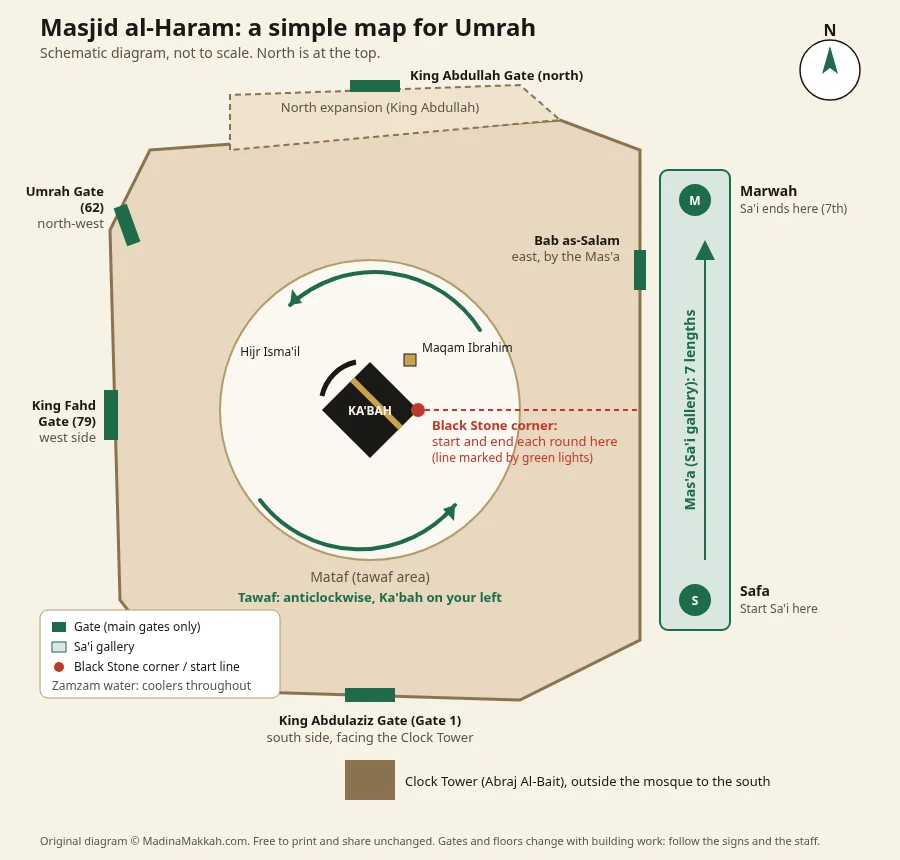
The map below shows the main gates, the Black Stone corner and Safa and Marwah. For more detail, see finding your way in Masjid al-Haram.
4. Tawaf: seven rounds
- Go to the line in line with the Black Stone corner (marked by green lights). Each round starts and ends here.
- Face the Black Stone, point towards it and say Allahu akbar. The Prophet ﷺ pointed to the corner and said takbir each time he came to it (Sahih al-Bukhari 1613). Do not push to touch it.
- Walk anticlockwise, with the Ka’bah on your left, for seven rounds. Men may walk briskly (ramal) in the first three rounds if there is space, as the Prophet ﷺ did (Sahih al-Bukhari 1603).
- Make dua and dhikr in your own words and language. You can say the Qur’anic dua: Rabbana atina fid-dunya hasanatan wa fil-akhirati hasanatan wa qina ‘adhaban-nar (Qur’an 2:201).
- Count your rounds: a tasbih counter or folding a finger each round helps in crowds.
Using a wheelchair or electric cart? Tawaf on the upper floors is the usual route; see Umrah with a wheelchair.
5. Two rak’ahs behind Maqam Ibrahim
After the seventh round, pray two rak’ahs behind Maqam Ibrahim if there is room, or further back where it is safe and you are not blocking people still in tawaf. Allah says: “And take, [O believers], from the standing place of Abraham a place of prayer” (Qur’an 2:125). Jabir reported that the Prophet ﷺ recited this verse there and, in the two rak’ahs, recited Surah al-Ikhlas and Surah al-Kafirun (Sahih Muslim 1218).
6. Zamzam
Drink Zamzam from the coolers around the mosque; the Prophet ﷺ drank from Zamzam (Sahih Muslim 1218). See Zamzam: drinking it and taking it home.
7. Sa’i: seven lengths between Safa and Marwah
Follow the signs to Safa. Allah says: “Indeed, as-Safa and al-Marwah are among the symbols of Allah” (Qur’an 2:158). When the Prophet ﷺ came near Safa he recited this verse and said, “I begin with what Allah began with” (Sahih Muslim 1218).
- At Safa, face the direction of the Ka’bah, praise Allah and make dua, as the Prophet ﷺ did (Sahih Muslim 1218).
- Walk to Marwah: that is length one. Marwah back to Safa is length two.
- Between the green lights, men walk briskly; the Prophet ﷺ hastened in the valley bottom between the two hills (Sahih Muslim 1218).
- The seventh length ends at Marwah.
- Wheelchair and cart lanes run alongside; the upper floors are usually calmer.
More detail: Sa’i between Safa and Marwah: what to expect.
8. Shave or trim your hair
Men shave the head or shorten the hair; women trim a small amount from the end of their hair. The Qur’an mentions entering the Sacred Mosque “with your heads shaved and [hair] shortened” (Qur’an 48:27), and the Prophet ﷺ prayed for mercy for those who shave and for those who shorten (Sahih al-Bukhari 1727). See cutting your hair after Umrah.
Your Umrah is complete. The ihram restrictions are lifted. What to do after Umrah.
Keep an offline meeting plan
- Write down your hotel address and group leader’s telephone number; keep a paper copy as well as your phone.
- Before you start, agree a clear meeting point with your group. The Ministry’s Umrah and Visit Guide suggests using the mosque’s internal door numbers so that you do not get separated.
- For entry, exits and upper levels, follow the current gate signs and mosque staff rather than relying on a schematic map. Gate access may change with crowd management.
If you are deciding whether to perform Umrah immediately after your flight, read Umrah on the day you arrive. For finding entrances and recognising signs, see finding your way in Masjid al-Haram. The diagram below is an orientation aid, not a live access or evacuation map.
Map of Masjid al-Haram
If you need help
- Emergency: call 911, the unified emergency number in the Makkah region.
- Lost from your group: go to the meeting gate you agreed. Staff at the gates and guidance points can help.
- Lost belongings or documents: see lost belongings and documents at the Haram.
- Heat and tiredness: drink water, rest in the shade or on an upper floor, and ask staff for medical help if you feel unwell. See staying healthy in heat and crowds.
FAQ
How long does Umrah take on the day?
Often two to three hours on foot, and longer in peak seasons such as Ramadan. The Ministry of Hajj and Umrah’s Umrah and Visit Guide gives about two to three hours on foot and one and a half to two hours by electric cart.
Do I need a permit to perform Umrah?
Yes. Book the free Umrah permit (a time slot) in the Nusuk app before you go to the Haram for Umrah.
Is the PDF really free?
Yes. Download it with the button at the top of this page. There is no sign-up and no email.
Related guides
- How to perform Umrah, step by step
- How to perform tawaf, step by step
- Can you perform Umrah on the day you arrive?
- What to carry into the Haram
Sources
- Sahih al-Bukhari 1549, Sahih al-Bukhari 1603, Sahih al-Bukhari 1613, Sahih al-Bukhari 1614, Sahih al-Bukhari 1727 (sunnah.com).
- Sahih Muslim 1218 and Sahih Muslim 713 (sunnah.com).
- Qur’an 2:125, Qur’an 2:158, Qur’an 2:201, Qur’an 48:27 (quran.com).
- Ministry of Hajj and Umrah, Umrah and Visit Guide.