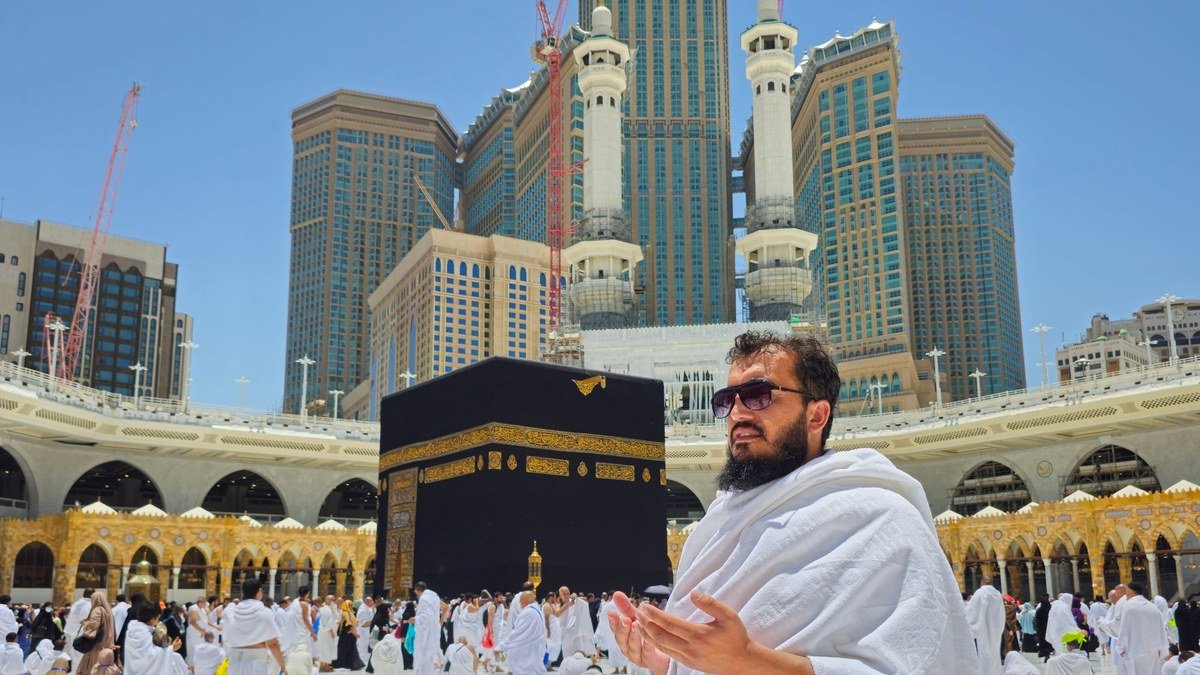
By Dr. Malik Sherjeel Awan, PsyD · Last checked 23 November 2026 · Confirm details with a qualified scholar
Published by Dr. Malik Sherjeel Awan, Makkah
Ihram is the sacred state a pilgrim enters to perform Hajj or Umrah. It begins with an intention and the talbiyah, and for men it is marked by two simple white cloths. If you have performed Umrah, ihram will feel familiar. For Hajj there are a few differences in timing, especially if you perform tamattu’. This guide covers them.
What ihram is
Ihram is not just the clothes. It is a state you enter with:
- an intention (niyyah) in the heart to perform Hajj (or Umrah, or both)
- the talbiyah, said aloud by men and quietly by women, as scholars teach
The official Nusuk Hajj guide puts it simply as the first step: start “with a sincere intention to enter the state of Ihram and engage in the rituals of Hajj, with the recitation of the Talbiyah. Then, put on the Ihram garments.”
When to enter ihram for Hajj
It depends on your type of Hajj (see types of Hajj: tamattu’, qiran and ifrad):
- Tamattu’: at the miqat, you enter ihram for Umrah. After Umrah you leave ihram. You then enter ihram for Hajj again, usually on 8 Dhu al-Hijjah (expected around Friday 14 May 2027, depending on the moon sighting; check the official announcement), from where you are staying in Makkah, before going to Mina. A narration in Sahih al-Bukhari describes Companions staying out of ihram “till the day of Tarwiya” and then assuming ihram for Hajj (Sahih al-Bukhari 1568).
- Qiran and ifrad: you enter ihram for Hajj (with Umrah, in qiran) at the miqat and stay in it until the Day of Eid.
If you are travelling from Madinah, your miqat is Dhul Hulayfah, which the Prophet ﷺ set for the people of Madinah (Sahih al-Bukhari 1524). Our sister site explains the journey: Madinah to Makkah for Hajj. For the miqat points in general, see miqat for Umrah.
Before you enter ihram
Many pilgrims, following the Sunnah as scholars describe it:
- take a bath (ghusl)
- trim nails and remove unwanted hair beforehand, since they can’t be cut in ihram
- men apply perfume to the body (not the ihram cloths) before ihram. Aisha said: “I used to scent Allah’s Messenger (ﷺ) when he wanted to assume Ihram” (Sahih al-Bukhari 1539; Sahih Muslim 1189)
- pray, and then make the intention
The talbiyah
Ibn Umar reported the talbiyah of the Prophet ﷺ (Sahih al-Bukhari 1549; Sahih Muslim 1184):
Labbaika Allahumma labbaik, labbaika la sharika laka labbaik, inna-l-hamda wan-ni’mata laka wal-mulk, la sharika lak.
“I respond to Your call O Allah, I respond to Your call, and I am obedient to Your orders, You have no partner, I respond to Your call All the praises and blessings are for You, All the sovereignty is for You, And You have no partners with you.”
Pilgrims repeat it often from the start of ihram. Practise it at home now so it comes easily on the day.
What men and women wear
Men wear two unstitched cloths, one around the waist and one over the shoulders, and sandals that leave the ankles uncovered. The Prophet ﷺ said the person in ihram “should not wear a shirt, a turban, trousers, a headcloak or leather socks”, and should not wear clothes scented with saffron or wars (Sahih al-Bukhari 1542; Sahih Muslim 1177).
Women wear their normal modest clothing. Scholars explain that no special garment or colour is required. The Prophet ﷺ said a woman in ihram “should not cover her face, or wear gloves” (Sahih al-Bukhari 1838). Scholars explain how a woman may lower a cloth in front of her face in the presence of men who are not her mahram. For more, see what women wear in ihram.
The main restrictions in ihram
Once in ihram, a pilgrim avoids:
- Cutting or removing hair or nails. “Do not shave your heads until the sacrificial animal has reached its place of slaughter” (Qur’an 2:196).
- Perfume on the body or clothes, and scented soaps, as scholars explain from Sahih al-Bukhari 1542.
- Covering the head (men) and covering the face with a niqab or wearing gloves (women).
- Sexual relations and anything leading to them. “There is [to be for him] no sexual relations and no disobedience and no disputing during ḥajj” (Qur’an 2:197).
- Marriage contracts and proposals. “A Muhrim must neither marry himself, nor arrange the marriage of another one, nor should he make the proposal of marriage” (Sahih Muslim 1409).
- Hunting land animals. “Do not kill game while you are in the state of iḥrām” (Qur’an 5:95); game from the sea is lawful, but “forbidden to you is game from the land as long as you are in the state of iḥrām” (Qur’an 5:96).
- Arguing, insults and bad behaviour, per Qur’an 2:197.
According to many scholars, using unscented soap, changing ihram cloths, using an umbrella, wearing a watch or glasses, and taking needed medicine are allowed. Ask your group’s scholar about specific cases.
What if I break a restriction by mistake?
Many things done by forgetting or by genuine ignorance carry no penalty, according to many scholars. For acts done out of need, such as shaving because of an ailment of the head, the Qur’an mentions “a ransom of fasting [three days] or charity or sacrifice” (Qur’an 2:196). Deliberate violations have their own rulings, which scholars explain and the schools differ on. Don’t panic and don’t guess. Tell your group’s scholar exactly what happened and follow the guidance.
When does ihram end?
Ihram for Hajj ends in two stages, as scholars explain:
- First release, on the Day of Eid (expected around 16 May 2027, depending on the moon sighting), commonly explained as coming after you stone Jamrat al-Aqabah and shave or trim your hair. The schools differ on exactly which acts bring it. Most restrictions lift, but marital relations remain forbidden.
- Full release, after Tawaf al-Ifadah (and sa’i, where required). Aisha said she perfumed the Prophet ﷺ “on finishing Ihram before the Tawaf round the Ka’ba (Tawaf-al-ifada)” (Sahih al-Bukhari 1539).
Details of the order on the 10th vary between schools. Your group will guide you.
Ihram and the mind
As a psychologist, I find ihram one of the most beautiful parts of Hajj. You set aside the clothes that show status, job and nationality, and stand like everyone else. It can feel exposing at first, especially for people who rely on their appearance for confidence. That discomfort is worth noticing. Let it remind you that what Allah looks at is the heart.
Practically: try on your ihram at home, walk in it, sleep in it for a night. Familiarity lowers anxiety, and your attention on the day can go to worship rather than to the cloth slipping off your shoulder.
FAQ
Can I put on the ihram cloths at home and make the intention at the miqat?
Yes, many pilgrims dress at home or at the airport, and make the intention at or before the miqat. On a flight, make it before the plane passes the miqat.
Where do tamattu’ pilgrims enter ihram for Hajj?
Usually from their place in Makkah on 8 Dhu al-Hijjah, as scholars explain. Your group will tell you the time.
Can I use a belt or a bag in ihram?
Generally yes, according to many scholars. Ask your group’s scholar if unsure.
Related reading
- Hajj 2027 dates and how to register on Nusuk
- How to perform Hajj
- Entering ihram: clothes, timing and what to avoid
- What women wear in ihram
General guidance only, not a fatwa. Schools of fiqh differ on some details. Consult a qualified scholar for your own Hajj.
Sources
- Qur’an 2:196, 2:197, 5:95, 5:96 (Sahih International, quran.com)
- Hadith: Sahih al-Bukhari 1549 and Sahih Muslim 1184 (the talbiyah) https://sunnah.com/bukhari:1549 , https://sunnah.com/muslim:1184
- Hadith: Sahih al-Bukhari 1542 and Sahih Muslim 1177 (what the muhrim does not wear) https://sunnah.com/bukhari:1542 , https://sunnah.com/muslim:1177
- Hadith: Sahih al-Bukhari 1838 (the woman in ihram does not cover her face or wear gloves) https://sunnah.com/bukhari:1838
- Hadith: Sahih al-Bukhari 1539 and Sahih Muslim 1189 (perfume before ihram and before Tawaf al-Ifadah) https://sunnah.com/bukhari:1539 , https://sunnah.com/muslim:1189
- Hadith: Sahih Muslim 1409 (the muhrim does not marry or propose) https://sunnah.com/muslim:1409
- Hadith: Sahih al-Bukhari 1568 (ihram for Hajj on the day of Tarwiyah in tamattu’) https://sunnah.com/bukhari:1568
- Hadith: Sahih al-Bukhari 1524 (the mawaqit; Dhul-Hulaifa for Madinah) https://sunnah.com/bukhari:1524
- Nusuk Hajj, The Journey (step 1: intention, talbiyah, ihram garments): https://hajj.nusuk.sa/Journey
- Umm al-Qura calendar conversion (8 Dhu al-Hijjah 1448 = 14 May 2027; 10 Dhu al-Hijjah = 16 May 2027; subject to moon sighting): https://api.aladhan.com/v1/hToG/08-12-1448?calendarMethod=UAQ